
Payments, embedding and other settings
LEARNING GOAL: Knowing which other options are available to make the registration process easier.
After you’ve customized the registration page to match your corporate identity, consider the following options before you start promoting your webinar. After all, the registration process is not finished when you’ve customized the registration page.
Payment
Webinars are often used to share valuable information. Sometimes you have put a lot of time into the preparation, for example, to do research. For this reason, it can make sense that you let viewers pay to watch. If you organize a paid webinar, viewers have to pay to be able to participate.
Set up a paid webinar on the ‘Registration’ page under the header ‘Payments’. Here, you’re asked if you want to activate payments. WebinarGeek uses Mollie as a payment tool. If you don’t want to use Mollie, there are a number of other payment tools you can use through an integration. We’ll discuss this in more detail in chapter 5.
After you’ve linked your Mollie account to WebinarGeek, you can fill in the amount you want viewers to pay. The amount should be between € 1 and € 1,000. Do you want to know more about setting up the connection with Mollie? Then have a look at our [On-demand Academy] for an elaborate explanation and a video about creating a Mollie account and setting up payments.
Would you like to give a number of participants access to the webinar with a discount? Then you can create a discount code and share it with these participants. Don’t forget to add an extra field to the registration page, in which participants can fill in the discount code.
Embedding
You may want to keep registrants on your own website, instead of sending them to a separate registration page. That’s why we created the option to embed the registration form on your website, through the embedded form.
Just like the registration page, you can customize the embedded form to match your corporate identity. All fields on the registration page are also shown in the embedded form.
After you’ve set up the embedded form, a piece of code and a URL will appear. You can use the code on your website. Are you placing the form in an iframe? Then use the URL.
Registrants are sent to the confirmation page after registering. If you want registrants to stay on your website after they’ve registered, add a URL to a confirmation page of your own. That way you will have moved the entire registration process to your own website.
Settings
There are a number of additional settings that you can adjust to simplify the registration process even more.
Go to the ‘Registration’ page under the header ‘Settings’ to adjust the following settings:
Registration after the webinar has started: Decide whether people can still register for the webinar after it’s started.
Restrictions based on email domains or IP addresses: Exclude email domains or IP addresses from registration. If you use this setting, the webinar will be discrete and only relevant viewers will be able to watch it.
Limit the number of registrations: Set a maximum number of registrations for the webinar.
Limit the number of viewers: Set a maximum number of viewers for the webinar. This limit does not apply to the number of registrations.
Password security: Secure the webinar by setting up a password. Only viewers with the password can access the webinar.
Adjust the settings to match your preferences, bearing your webinar goals in mind. Would you like to welcome as many participants as possible? Then we recommend that you do not set any limits.
Are you organizing a webinar exclusively for in-house staff? Then you may want to exclude email domains so that only employees can participate.
What have I learned?
How I can set up a paid webinar
How I can create an embedded form
Which settings I can adjust during the registration process
Next courses

Einladen und Promoten
Veröffentliche dein Webinar, teile es mit der Welt und sammle wertvolle Daten über deine Teilnehmer!

Masterclass: Content-Wiederverwendung
Lerne, wie du deine Inhalte recycelst. Schau dir die WebinarGeek Masterclass an und werde ein Experte.
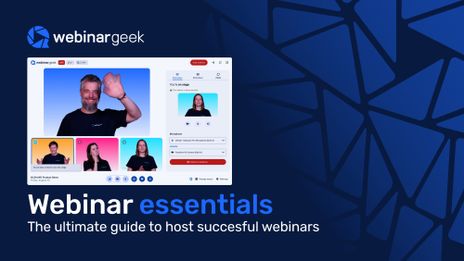
Webinar Essentials Ebook
Ein vollständiger Leitfaden zur Erstellung innovativer Streaming-Erlebnisse in Form von Webinaren. Warum solltest du Webinare hosten? Wie gewinnen Webinare Leads? Wie hebst du Trainingssessions auf ein höheres Niveau? Und vieles mehr wird in diesem E-Book behandelt.
Akademie: KI x Webinare
Explore how to use AI to create content for your webinars.

Zapier – Integriere mit 6.000+ Apps
Automatisiere Workflows, um Webinare effektiver und effizienter zu hosten.

Erstelle einen Content-Kalender mit Intercom
Intercoms Transformation von keinem Content-Kalender zu einer vollständigen Strategie und einem durchdachten Content-Kalender.

Steigere die Vertriebseffektivität mit Revenuecoach
Entdecke die LinkedIn-Geheimnisse von Franck Fielemon von Revenuecoach.com in einer Q&A-Session.

Wie du Webinare mit vMix streamst – Teil 3
Setze deine vMix-Reise mit dem letzten Teil unserer Serie fort! Erkunde Titel, Overlays, konfiguriere vMix mit WebinarGeek und erfahre, wie du deine Streams aufzeichnest. Hebe deine Streaming-Performance auf das nächste Level und entfessle deine Kreativität mit vMix.

Erstelle dein erstes Webinar: Ein Leitfaden für Einsteiger
Bereit für dein erstes Webinar? Schau dir unsere Videoserie „Ein Leitfaden für Einsteiger“ an – wir zeigen dir alles: von der Zielsetzung bis zur Themenwahl. Erfahre, wie du mit den Tools von WebinarGeek den Ablauf optimierst.

5 Kamera-Tipps für dein Webinar
Entdecke 5 Kamera-Tipps zur Verbesserung deiner Webinar-Videoqualität. Mit besserem Licht, Winkel und Bildausschnitt wirkst du professioneller und überzeugender.